

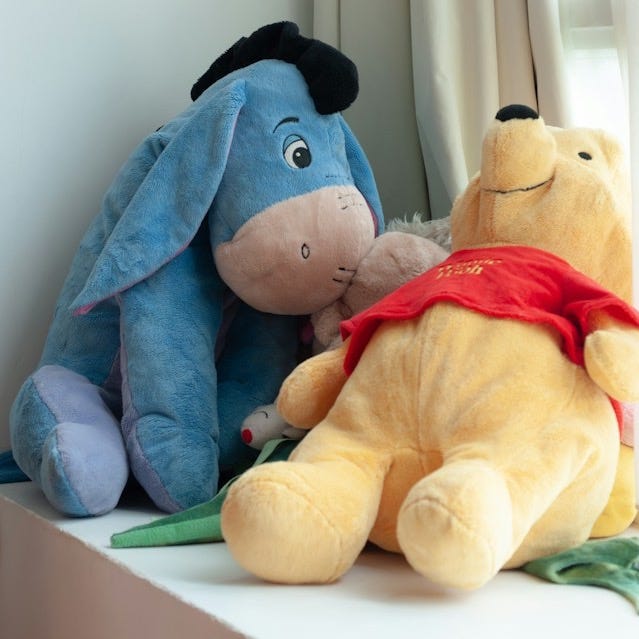
In October 1926, a book full of stories about a little bear and his friends was placed on a shelf in a London bookshop. By the end of 1926, Winnie-the-Pooh had sold 32,000 copies in the UK and 150,000 in the US.
The book has never gone out of print, and by 2017, the Pooh books had sold some 20 million copies in 50 languages. Even a Latin translation, Winnie ille Pu, made the New York Times bestseller list.
Ten years later (and a hundred years after its first publication), a new authorised sequel is being released in bookshops this week: ‘A Little Boy and His Bear,’ written by Jane Riordan.
My copy of Winnie the Pooh stories has an orange cover, with the bear and Christopher Robin standing by the tree, looking into the distance. The pages are weathered and yellow now, and a couple are missing. But it still makes me smile whenever my kids ask me to read it to them as a bedtime story — it reminds me of when my mum read it to me when I was little.
Why are we talking about Pooh?
The book was written by A. A. Milne, a playwright and a former assistant editor of Punch. The man was perfectly capable of cleverness, but when he sat down to write stories about his son’s toys, he did something most professional writers find terrifying.
He wrote small.
Short sentences with ordinary words, and stories about a hero proud to be a bear of very little brain.
“I am a bear of very little brain, and long words bother me.”
Adults still quote Pooh at weddings, birthdays, and other special occasions. Quotes appear on birthday cards, bookmarks and even fridge magnets — All because of the magic of simple writing.
Why does simple writing matter?
[…]
Psst… This is where the preview ends.
Pooh would call this a ‘Very Rude Interruption’.
My subscribers got the full issue straight to their inbox.
Here’s what they found out:
Why easy-to-read copy feels easier to believe, and what that means for your buy button.
The study that found fancy words make writers look less intelligent. (Its title is so long-winded it won a prize.)
A real “before” opening I’d never send, and the Pooh-style rewrite that makes the next line hard to skip.
Three rules for writing like a bear, starting with the one question to ask before every word.
What Piglet and Pooh can teach you about letting feelings do the selling.
A small centenary challenge you can try this week. (I’m doing it too.)
You don’t have to settle for the preview.
Subscribe below, and the next issue gets straight to your inbox.